Thursday, May 22, 2014

Rosie The Riveter Visitor Center in Richmond, CA

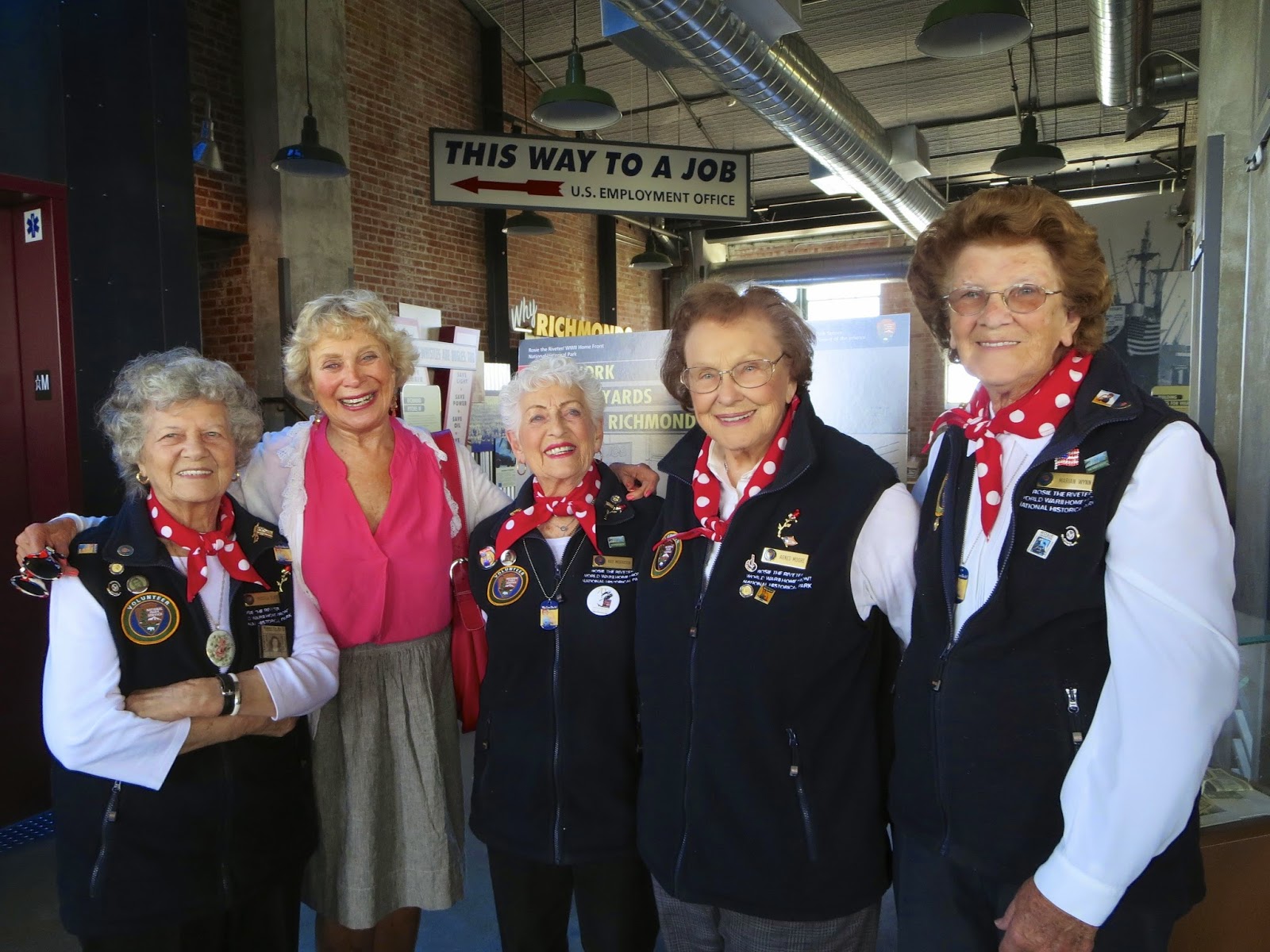
Last week, to celebrate Dixie's birthday, Dixie, Mary Ann, Kathy, and I headed off to Richmond to the Rosie the Riveter Visitor Center. The Center is part of the Rosie the Riveter/World War II Home Front National Historical Park.

Dixie, who grew up in California, remembers the Rosies when they were building ships at this location during World War II. While she wasn't a Riveter herself, she still has many memories of that time.

Earlier this year, several of the Riveters traveled to Washington D.C. to be honored for their service to the United States. Their visit was the subject of the radio and TV news and the newspapers.  One of the Riveters, Kay Morrison, even gave President Obama quite a kiss!

We planned our visit several months ago.  As it happened, our timing was perfect timing for us to get a preview of the new exhibits in the Visitor Center that are opening this coming weekend (Memorial Day weekend).
 
Our first stop was at the Visitor Center where we were greeted by four of the Riveters. They are here every Friday from 10 a.m. until 2 p.m. In the picture above, they are, from left to right, Priscilla Elder, Kay Morrison, Agnes Moore, and Marian Wynn. Kay, proudly, is the one who kissed President Obama and, as she said to me, "He's my president. I can kiss him!"

What delightful and enthusiastic women they are!  They introduced themselves to us and told us what their jobs were during the War and in which building they worked. We got to chat with them several times during our visit, each time learning more about what it was like for them to work building war ships.

The Kaiser shipbuilding plant, which was here, completed a ship nearly every day. The Riveters worked 'round the clock. The record time to construct a ship from start to finish was that for the SS Robert E. Peary which was constructed in less than 5 days; the average time was less than a month.

Dixie recalled that their salaries were very good. At that time, she was earning 50 cents an hour in an office job, while the Riveters earned $1 an hour for their first 40 hours of work during the week. If they worked on Saturdays, they earned time and a half, and, on Sundays, they earned double time. One of the films we watched in the Center's theatre said that the average work week for them was about 60 hours long.

During our visit, there was a press preview of the new exhibit and we got to see it too. There is a riveting station set up where they display their riveting technique. Several videos about life during the war play continuously.

The Visitor Center is open daily. While the Riveters are usually here only on Fridays, volunteers and National Park Rangers are here every day.  Everyone we met was well informed and eager to talk about the World War II years and about Richmond as a Bay Area boom town.

RIVETING

VIDEOS/DISPLAYS
OTHER PARTS OF THE EXHIBIT

We took a break from the Visitor Center for lunch at Assemble, the restaurant in the former Ford Motors Assembly Plant next door to the Visitor Center. During World War II, President Roosevelt banned civilian automobile production. During the war, this Ford Assembly Plant assembled 49,000 jeeps and put the finishing touches on 91,000 tanks, half-tracks, armored cars and other military vehicles destined for the war.
Lunch, too, was a delightful adventure.  The "decor" of the restaurant is that of an automobile assembly plant. Ironically, as if in tribute to the restaurant's delicious and creative menu, there are video screens in the dining room playing reruns of Julia Child television shows. Three noted Bay Area chefs, Richard Massera (César, Chez Panisse), Terumi Shibata-Mazzera (Downtown, Corso) and Maggie Pond (César) have created a menu of "re-tooled American classics."

Assemble is popular at lunchtime. I suggest making a reservation. They serve lunch weekdays, brunch on weekends, and dinner Wednesday through Saturday.


Some of Assemble's food is grown in their on-sight Victory Garden. Many items on the menu are throwback dishes to the war time, but are prepared with fresh, local ingredients.

We started our meal by sharing an order of Spiced Boiled Peanuts, described as a "Dixieland Delight" and prepared in a broth with chilies, coriander, and fennel. They were fun to eat and so tasty that Kathy even drank the broth that remained after all the peanuts were gone.

Dixie's lunch choice was the  Grilled Cheese Sandwich, made with swiss, cheddar, and pepper jack cheeses, and a cup of Tomato Soup.
Mary Ann had the Chicken Pot Pie with Cheddar Cheese Crust.
Kathy had the Triple Club Sandwich (chicken breast, roast turkey, pepper bacon, a fried egg, tomato, and avocado aioli, all on Acme bread.
My choice was the Blackened Catfish Sandwich.
Servings are very generous. And, despite our saying that it was way too much to eat, we ate every last bite.  And, we even shared a slice of Key Lime Pie, Dixie's birthday dessert.


We spent most a day just at the Visitor Center and having lunch at Assemble.

But, there is more to see/visit within the Park.  Of particular interest is the Rosie the Riveter Memorial (open year 'round, dawn to dusk) and the SS Red Oak Victory ship.  The Red Oak is in the process of being renovated by volunteers and can be boarded for visits on Weekends, Tuesdays, and Thursdays from 10 a.m. to 3 p.m.).  To get to either or both of these attractions, you will need to drive from the Visitor Center.  There are maps, information, and a printed Self-Guided Auto Tour in the Visitor Center.


Friday, March 28, 2014

The Ruth Bancroft Garden: Inspiration for Drought-Tolerant Planting & Landscape


In this year of drought in California, the thoughts of many Californians are turning to plants and landscapes that can tolerate dry weather conditions.

Earlier this year I was invited to a private tour of The Ruth Bancroft Garden. Although I live just a few miles from the Garden, I had come to take its presence for granted and rarely visited.

Spending a few hours at the Garden with docent Adrian D'Souza (pictured above, pointing out a very large Agave Americana variegated) reminded me that the Garden is a true hidden treasure in the San Francisco Bay Area. It is now high on my list as a tranquil and inspiring spot for gardening insights, as well as a lovely spot to relax and to bring visitors.

More than 50 years ago, Walnut Creek, California, resident Ruth Bancroft, who is now 105 years old, had already planted her 3.5-acre garden with succulents and other plants that could thrive with very little water. She had purchased her first succulent plant in the 1950s and continues to acquire them. Mrs. Bancroft was, and still is, well ahead of her time with respect to plants and gardens that thrive in arid climates.

In 1989 the Garden became the first preservation project of The Garden Conservancy, a nonprofit organization dedicated to preserving exceptional American gardens. The Garden has been open to the public for tours and visits since 1992.

Mrs. Bancroft's first drought-tolerant plant was an Echeveria. These lovely rosette-shaped plants remain a part of the Garden's landscape.


There are at least 150 species and hybrids of Aloe and and 50 species of Agave in the Garden.

This photo shows both Aloes and Agaves, as well as other succulents.


These are more succulents that intrigued me.


The Ruth Bancroft Garden consists of much more than succulents.

In the foreground of this photo is an Xanthorrhoea, an Australian Grass Tree. Behind it is a Washingtonia filifera, a California Fan Palm.

Here is a cluster of the Fan Palms. The dead leaves that hang down over the tree trunks form a protective area that provides a habitat and shelter for such creatures as birds, insects, and small rodents.


This Kapok tree was not in bloom when I saw it in January, but chances are that it has leaves by now.


The Garden is open to visitors Tuesday through Saturday from 10 a.m. until 4 p.m.; admission is charged (free admission the first Tuesday of each month; members visit for free all the time). Children are welcome (they will be given a special "Children's Garden Quest" to guide them through the Garden). There are picnic tables on site.

Visitors can do self-guided tours (booklet available with admission) or take a docent-led guided tour (April-October: Friday, Saturday, Sunday; November-March: Saturdays). Private group tours can be scheduled in advance.

Also, when you visit the Garden, you will receive a map and numbered "What's in Bloom?" guide to what's blooming that month. The guide includes horticultural details of each plant included in the guide.


The "What's in Bloom?" guide also indicates which plants can be purchased in the Garden's nursery. Be sure to save time to browse, and be tempted by the plants and decorative garden items that are for sale in the nursery and in the main office.


Coming up on Saturday, April 12, 2014 is the Garden's Spring Plant Sale (11 a.m. to 3 p.m.). It is said to feature the Bay Area's best selection of succulents, cacti, and other drought-tolerant plants. Staff and volunteers will be there to provide dry garden advice. While the Garden's Nursery offers plants for sale throughout the year, the best selection is available for this Spring sale and their Fall sale in October. Admission is Free on Plant Sale days.

Other events (some require advance reservations) in the next few months include:

•  A Private Tour of Ruth's Gardens: Saturday, May 10, a tour of the gardens around Ruth Bancroft's home which is behind a fence on the property.

•  Mother's Day, Sunday, May 11, a family day at the Garden with special guided tours and activities. Bring a picnic to enjoy in the Garden, or reserve for a catered Mother's Day Tea (reserve online; two seatings).

•  Sculpture in the Garden, June 13 -July 13, with special events on the opening weekend, which is Father's Day weekend.

•  Bluegrass Sunset Social, August 15, featuring the Alhambra Valley Band.


Wednesday, February 26, 2014

Deserts of the World, and More

In anticipation of the rain we got at the end of this week, we tried to do our outdoor activities early in our Palm Springs stay.

We spent most of a day at the Living Desert in Palm Desert. Even spending 5 hours there, we could not cover everything. If we lived here, we'd certainly become members and visit often.

The Living Desert is a nature preserve on 1200 acres, 1080 acres of which are un disturbed Sonoran Desert. Its exhibits feature plants and animals from deserts all over the world. And, if this is not enough, it includes extensive nature trails, a small campground, a wildlife veterinary hospital, a carousel where you ride on endangered species carousel animals, aviaries, an enormous G-scale model railroad and so much more. For those who don't wish to walk the full area, there is a shuttle that makes frequent stops throughout.

The first "attraction" that captured our attention was the special exhibit. Birds of the Australian Outback. It's an interactive aviary exhibit in which very friendly parrots climb all over those who enter their tent. Not only do the parrots eat the millet seed food off the sticks we were given, they also explore your pockets, purses, bags and all else. Before leaving the tent, a docent checked us to make sure no bird has slipped into our clothing or bags.

After thoroughly amusing ourselves with these colorful parrots...notice how the ones on Jim seem to match the colors in his shirt?...we wandered through desert plants, the living Desert's nursery ( I managed to resist the temptation to purchase after considering that I'd have to keep my purchases alive for several weeks before I'd actually get them home.), the veterinary hospital, and the animal exhibits. The rest of this blog is more photos of our meandering.

Monday, February 24, 2014

Back in Palm Springs

It's that time of year, and we are back in Palm Springs.
While much of the country is facing another attack by the not-so-elusive Polar Vortex, here, the sun is shining and the daytime temperatures are in the 80's. I'm happy as can be.

As I headed out this morning to meet Rosie for coffee, I was delighted to find Marilyn still here. She was supposed to move on last Spring but the City fathers ( and mothers) have managed to keep her here on Palm Canyon Drive, at least until March 27. Then, she really has to move to Connecticut where the artist who created her is having a major show of his work. Hopefully, Marilyn will eventually make Palm Springs her permanent home. She really fits right in here oh so well.

We met at Koffi in The Corridor and even were lucky enough to find a place to sit outside on the lawn garden. Rosie caught us up on all Palm Springs news and we also discussed the menu for the Academy Awards party she is catering this coming Sunday.

Two wonderful hours later, we parted, until our next visit next week. I spent the afternoon at our pool.

Dinner tonight was at Thai Smile, one of our favorite spots. In the past year, Thai smile has moved to a much larger location at the corner of Indian Canyon and Tahquitz Canyon Drives, right in the center of town.

The food is as good as ever and , even at 6:30 on a Monday night, there was a line of people waiting for a table

We started with the Fresh Shrimp Spring Rolls and then had Panang Curry with Shrimp and Pad See-Ew, a noodle dish made with wide rice noodles, broccoli, and egg in a sweet black bean sauce. We chose sliced pork for the meat ingredient. The noodle dish was new to us. Everything was delicious and we even came home with leftovers. In the many years that we've dined at Thai Smile, we always marvel at their well-prepared dishes that are made with the freshest of ingredients.

And, so ends our first full day in paradise.